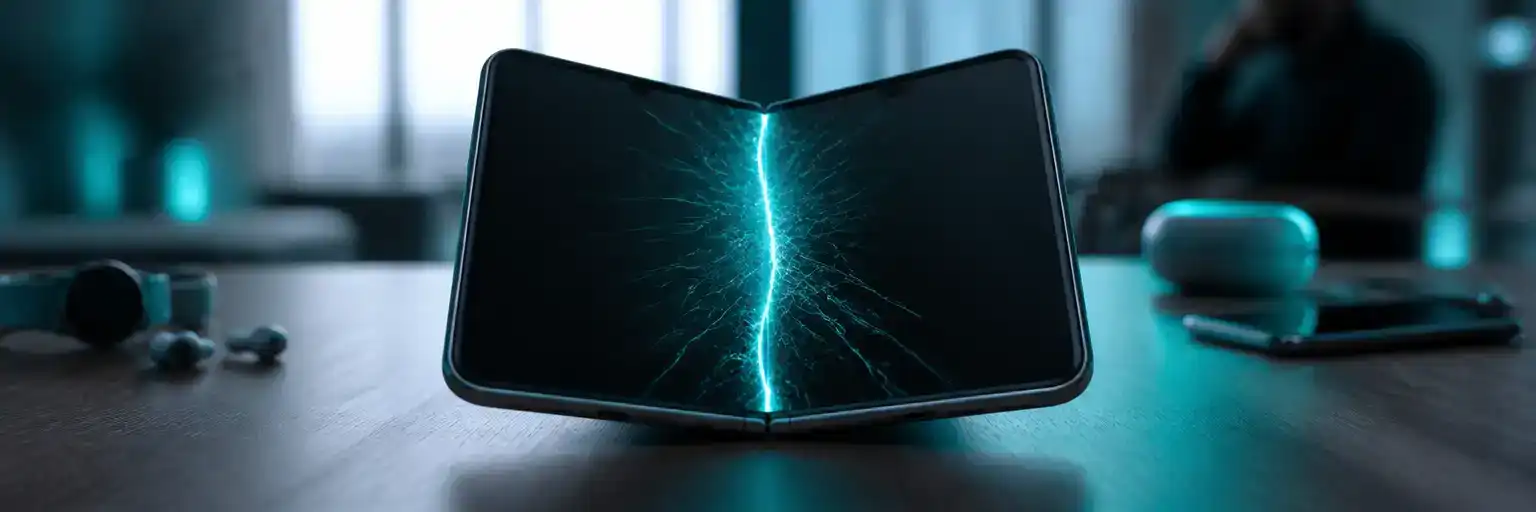
The iPhone Duo's cracks look like a design problem, not bad luck
iFixit's teardown points at the hinge and the inner screen's support, and a foldable that starts at $1,999 deserves a clear warranty policy, not an argument over who dropped it.
AI-generated image
Is it bad luck when a phone that starts at $1,999 shows a screen defect within days of launch, or is it the phone doing what it was designed to do? After iFixit's teardown, we lean toward the second answer, and we think Apple owes buyers clarity on how it will treat these failures.
The iPhone Duo reached stores on October 23, according to a retailer guide that cites Apple's dates. Within days, owners were posting cracked screens and display problems on Reddit. MacRumors reports that iFixit's teardown found the breaks cluster near the transition between the gap for the crossing flex cable and the central hinge support.
The pattern points at the hinge, not at clumsy owners
iFixit is careful, and we should be too. It lists several possible causes: pressure, a trapped particle, repeated bending or a manufacturing defect. It even notes that a wiring fault could look like a physically broken panel. There is no smoking gun.
But the location matters. iFixit built a 3D hinge model from teardown footage, patents and CT scans, and the reported damage sits slightly below where the display cable passes, at a point where several edges meet and change how the thin display is supported. That is a geometry story. In our view, random drops don't cluster in one spot. Design does.
The dust test adds to this. Per MacRumors, particles got into the hinge and made it crunch, which could lead to screen damage. In fairness, the Duo's hinge gathered less dust than the Galaxy Z Fold8's or the Pixel 11 Pro Fold's, and iFixit called that "encouraging." Our view: that is a good result for a first attempt and still not a reason to relax. A moving part that admits grit is a moving part that may eventually press grit into a flexible panel.
A caveat that cuts the other way: we don't have a failure rate. Social media amplifies failures, and nothing in the documentation tells us how widespread this is. So the honest claim is "plausible design weak point," not "recall."
Blaming the buyer is the wrong default for a $1,999 phone
Here is what bothers us most. PhoneArena reports a case where Apple claims a broken inner display was dropped, after only three hours of use, and refuses to honor the warranty. That is one report, and we haven't seen Apple's full side. But if the cause may be structural, the burden of proof shouldn't fall on the buyer.
The money is not trivial. Apple's repair estimator reportedly puts inner display damage at $999 out of warranty and outer display damage at $379, though Apple says it inspects each device before giving a final fee. The reported AppleCare+ fee for inner-display accidental damage is $99. Apple's standard warranty doesn't cover accidental damage, so the whole dispute turns on one question: was it an accident or a defect? A foldable with a plausible mechanical stress point makes that question much harder to answer by looking at a cracked screen.
What we'd want from Apple is simple. First, a public statement of what counts as a manufacturing defect on the inner display. Second, a clear path for early failures that doesn't start with an accusation. Third, an explicit extension or goodwill policy while the cause is investigated. None of this is exotic; it is what you owe people paying $1,999 or more.
Early adopters are funding the learning curve
The teardown isn't all bad news, and we should say so. iFixit gave the Duo a provisional 5 out of 10 for repairability, ahead of the Galaxy Z Fold8 and Pixel 11 Pro Fold at 4. It praised the battery removal, the robust outer display and a repair manual from day one. Its own verdict: "This is the most repairable foldable smartphone we've seen so far, and it's still going to be a bear to repair."
That is the real story. Apple did serious engineering and still shipped its first foldable with a possible weak spot where the display bends. We think that's normal for new categories, but normal doesn't mean the buyer should pay for it. Whoever pays $1,999 or more on day one is financing Apple's learning curve.
Our verdict
If you already own a Duo, keep it clean, avoid the beach (iFixit suggested it's not a great device for it), and seriously consider AppleCare+, because the gap between $99 and $999 is the real insurance case here. Document any defect right away. If you haven't bought one, waiting a few weeks is the cheap move: we'd want to see Apple's explanation and a clearer failure picture first. And to Apple: a clear policy beats a case-by-case argument every time.
No topics yet: start the first one.
More stories
Apple's iPhone Duo needs a durability promise, not a blame-the-user policy
A reported inner-display break after three hours, a warranty refusal and a $999 repair price: a first-generation foldable needs a clear guarantee, not a shrug.
iPhone Duo's battery isn't the story: its software still has to catch up
A 4,883mAh battery is respectable, not remarkable. What will decide whether the $1,999 foldable is worth it is how fast apps learn to use all that extra screen.
The iPhone Duo jailbreak shows novelty is no longer a shield
A launch-day jailbreak, helped by AI, suggests Apple can't count on fresh hardware to buy time. Buyers should judge it by how fast patches arrive, not by perfection.
iPhone Duo's cracked creases are the real launch test, not the reviews
Scarce stock hides the first crease failures on Apple's $1,999 foldable. Before anyone pays that premium, Apple owes buyers plain answers on warranty and repairs.